PMHP at UCLA

California Behavioral Health Services Act
ACT and FACT Center of Excellence

The state of California that includes drawn graphics of a redwood tree, mountains, the Golden Gate Bridge, beach with palm trees and a surfboard, a cactus and the California State flag that features a red star in the upper left corner and a grizzly bear in the middle

The Behavioral Health Services Act brings Assertive Community Treatment (ACT) and Forensic Assertive Community Treatment (FACT) to California.

For fifty years, ACT has helped people with severe mental illness thrive in the community. ACT brings care to people in their homes, in shelters, in group living settings, in locked settings, and on the street. ACT overcomes barriers to care to support recovery and community integration for those with the most significant behavioral health needs. We know that, when done well, ACT will improve client outcomes, reduce institutionalization and justice-involvement, reduce homelessness, and enhance client wellbeing.

Resources for behavioral health delivery systems and behavioral health practitioners

PMHP at UCLA is proud to serve as a Center of Excellence (COE) for the implementation of the Assertive Community Treatment (ACT) and Forensic Assertive Community Treatment (FACT) evidence-based practices (EBP) as part of California’s effort to expand access to and strengthen the continuum of community-based behavioral health services for individuals living with significant behavioral health needs. Go to the Behavioral Health COE Resource Hub for information about participating COEs and EBPs.


What is
Assertive
Community
Treatment?

The Public Mental Health Partnership (PMHP) at UCLA will provide training to ACT and FACT providers in California to support implementation and fidelity.
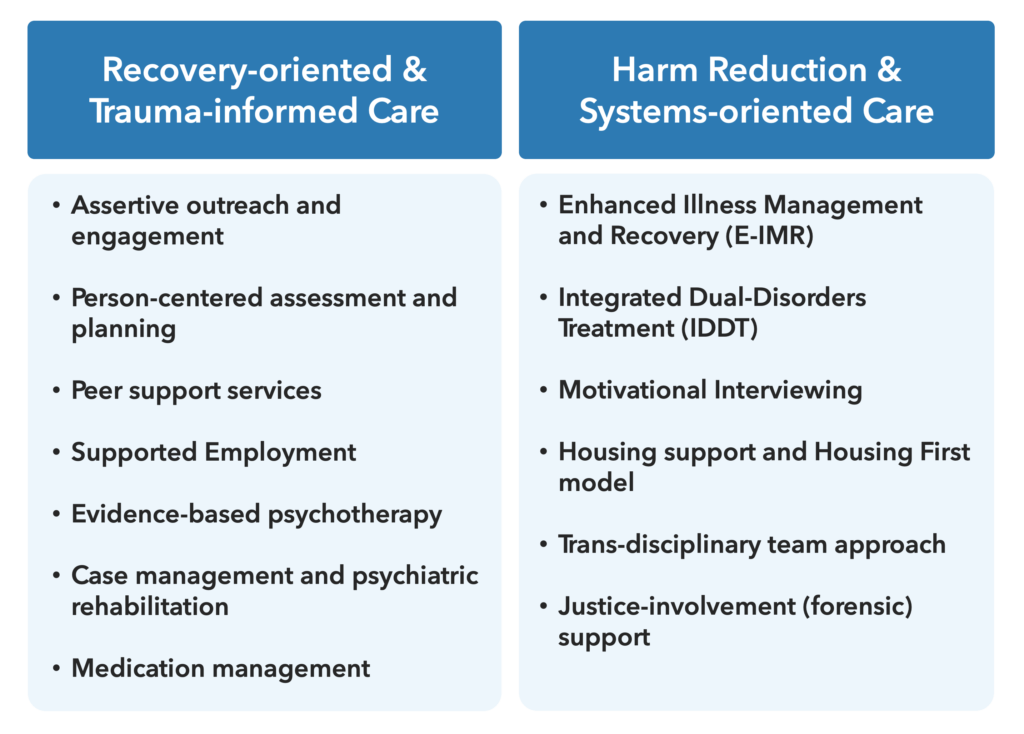
PMHP’s training curriculum is built on four core approach pillars: Recovery-oriented Care, Trauma-informed Care, Harm Reduction, and Systems-oriented Care, and encompasses the ACT service delivery model and team approach, evidence-based practices, and relevant clinical competency areas. Training will be offered online via live training sessions and self-paced (asynchronous) courses.

Assertive
Community
Treatment
Best Practices

Helping Teams Thrive

Technical Assistance

Technical Assistance (TA) is one-on-one support offered to ACT teams to help deliver high-quality intensive behavioral health care. TA brings together tenets of the Continuous Quality Improvement (CQI) model, strategies for fidelity monitoring, and approaches for collaborative and data-driven decision-making to enable teams to describe and solve challenges, adopt best practices, and improve their services over time.

How It Works

TA Can Help With

ACT and FACT Data Tools

The Center of Excellence for ACT and FACT draws on partnered implementation approaches that help practitioners use data to develop skills in evidence-based practices, guide effective service delivery, and incentivize performance improvement. All data we collect will be shared back with teams in a timely, structured, and interactive way to help teams adopt data-informed care delivery approaches that improve their practice. Our training offerings will include topics such as the use of data to inform continuous quality improvement, the adoption of Measurement-Based Care, data-informed provider behavior change, and others. We will provide coaching and hands-on technical assistance to help providers use data to adopt effective care processes that positively impact members.


Fidelity Measurement
. As explained in this video describing the Core Components Checklist, teams will pursue an incremental approach to achieving fidelity. Teams will complete a baseline fidelity assessment using the Core Components Checklist within 9 months of beginning ACT or FACT service delivery. In subsequent fidelity reviews, the ACT and FACT Center of Excellence will measure teams’ fidelity to the ACT model using the TMACT (Tool for Measurement of Assertive Community Treatment).


Member Outcome Measurement
. ACT and FACT practitioners will submit member-level data to the ACT and FACT Center of Excellence as outlined below.

ACT and FACT Member Outcomes
DomainMeasurement Tool Completed by PractitionerFrequencyEstimated Time to Complete per Member
Quality of Life & Recovery

Illness Management and Recovery Scale (IMR)

+

Global Quality of Life Item (QOL-1; member self-report*)

Intake, every 6 months & at discharge5-8 minutes
Mood & Psychotic Symptoms

COMPASS-10

Intake, every 6 months & at discharge10-12 minutes
Functioning & Service Engagement

Daily Living Activities Scale (DLA-20)

+

Service Engagement Scale (SES)

Intake, every 6 months & at discharge5-8 minutes
Member Status
• Demographic Information
• Housing
• Justice & Legal Involvement
• Productive Roles & Meaningful Activities
Items capturing member statusIntake, every 6 months & at discharge5 minutes

*We recommend that members also complete the 15-item Questionnaire about the Process of Recovery (QPR) every 6 months to provide the team with person-centered, recovery-oriented information about member experience.

Further Reading
and Resources

Links will open in a new tab

Meet Our Leadership Team

Lisa Davis, PhD, LCSW

Associate Director

Headshot of Rosalinda Cárdenas

Rosalinda Cárdenas, MPA

Administrative Director

Elizabeth Mackey, LMSW

Director of Training

Nancy Aréchiga, MBA

Associate Administrative Director

Joseph Mango, MFA

Media Director

©2026 UCLA Public Mental Health Partnership